Vision and aims
All children, who attend Ridgeway Primary School, should enjoy and succeed in mathematics, regardless of background because mathematics is essential to everyday life, critical to science, technology and engineering, and necessary for financial literacy and most forms of employment. We believe that it is necessary to equip every child with a high-quality mathematics education, which provides ‘foundation for understanding the world, the ability to reason mathematically, an appreciation of the beauty and power of mathematics, and a sense of enjoyment and curiosity about the subject. (National Curriculum 2013)
Mastery at Ridgeway
We believe the ‘mastery approach’ to teaching is the underlying principle of securing a deep understanding. At Ridgeway, we use Mathematics Mastery to equip every child with the mathematical thinking and problem solving skills necessary to succeed in all areas of their lives, as children and as adults. Instead of learning mathematical procedures by rote, we want pupils to build a deep conceptual understanding of concepts, which will enable them to apply their learning in different situations. In order to achieve this, we ensure that each lesson is based around three key principles of learning, Conceptual Understanding, Mathematical Thinking and Language and Communication. These principles underpin maths learning at Ridgeway and aim to enable all children to communicate their understanding clearly using a wide range of mathematical vocabulary, reason, challenge and explain their learning in order to solve problems and create a well-rounded, deep understanding of mathematical concepts. This reflects the national curriculum aims as all children become fluent in the fundamentals of mathematics, reason mathematically and solve problems by applying skills in context.

Curriculum Drivers in Mathematics
ExpresSive Communicators
– Vocabulary is a key component of learning in mathematics. If children can communicate using accurate mathematical vocabulary then they express their understanding clearly.
HealThy Champions
– Mathematical activities, where appropriate, are encouraged to be conducted outside (particularly in EYFS.) This creates a positive attitude to the subject and keeps children active whilst learning appropriate mathematical concepts.
Life-Long LeArners
– The manipulatives, images and vocabulary used to support children’s learning in mathematics encourages them to develop their own understanding of a concept. These skills enable children to be problem solvers in life and lifelong learners.
WoRld Citizens
– In all lessons, mathematical concepts are taught through a range of year group specific contexts. Being exposed to mathematics in context throughout their schooling prepares children for their further education and beyond.
Open to PoSsibilities
– When teaching all mathematical concepts, links are made to real life or other areas of the curriculum and put into contexts that children can understand. This enables children to make sense of their learning and understand where this fits in day to day life and the wider world.
Implementation
Organisation of the Curriculum
At Ridgeway, our curriculum follows guidelines and planning from Mathematics Mastery, which is used as a tool in conjunction with Ridgeway’s Progression and Vocabulary Document.
The overview of planning from Mathematics Mastery is broken down into threshold concepts that are covered across the school. These concepts are Number and Place Value, Addition and Subtraction, Multiplication and Division, Ratio and Proportion, Fractions, Decimals, Percentages, Time, Measures and Money, Statistics, Shape and Space and Algebra.
For each of these concepts, in each year group, there are set objectives that should be taught through lessons of mathematics. These concepts are organised across the year in a progressive way so that children can apply learning from previous units to new learning in following units. The progression document in place sets out each threshold concept and includes the objectives taught for this concept in each year group so that it is clear to see learning that has come in year groups before and learning that will come in subsequent years.
In each year group across the school, there are 4 mathematics lessons a week which enables all of the mathematical objectives to be taught within the academic year. Across the year, all units are taught in blocks so that there is clear progression within a sequence of lessons. In addition to this, concepts are revisited throughout the year in Maths Meetings, lesson starters and interventions to ensure children retain their understanding.
Curriculum Progression
Planning from Mathematics Mastery ensures that progression is catered for as children move through the school as well as links made to previous knowledge. The units taught across an academic year systematically build upon children’s prior knowledge, build upon their understanding of each concept and make links to other areas of mathematics.
Ridgeway’s progression document for mathematics has also been created in conjunction with the planning guidance from Mathematics Mastery. This document ensures progression is made both across an academic year and across each child’s journey through their primary schooling. Each threshold concept is set out with the objectives for each year group so it is clear to see the start and end points for this concept.
Also in place, there is a progression for vocabulary document. Vocabulary, language and communication are key elements of mathematics education and this document provides staff with the key terminology for each threshold concept for every year group across the school (YR-Y6.) This document is also progressive from year group to year group and has clear starting and ending points. Each piece of vocabulary is matched with a definition and an example of how it can be used in context so that staff are clear on what is expected. Please scroll to the bottom of the page for links to our progression documents.
Supporting all learners
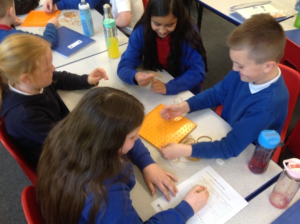
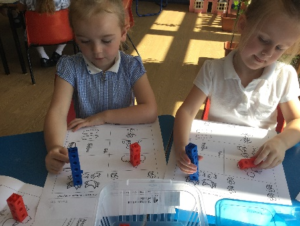
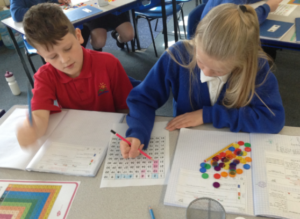
At Ridgeway, we ensure that every child is able to access the curriculum and are challenged appropriately by using scaffolding and constraint. All children, with a variety of needs, are supported in order to develop, challenge and extend their thinking. Questioning is an important way of achieving this as using a range of open-ended and deepening questions provide discussion and enable children to use their mathematical vocabulary in order to explain their thinking. Rich mathematical discussion encourages children to learn from peers, challenge their ideas and consider different opinions. This ethos supports children’s team work and develops their interpersonal skills for later life. To support and deepen learning, every child has access to a wide range of concrete manipulatives appropriate for all areas of maths that enable them to visualise concepts, explore and develop their understanding. This allows children to prove and disprove concepts, make links between mathematical concepts and create a well-rounded, deep understanding of the subject.
Times tables at Ridgeway
At Ridgeway, we view times tables as an integral part of mathematics that should be taught explicitly in order for children to use and apply these facts in other areas of maths.
Times tables are taught in 30 minute sessions and these sessions focus on teaching patterns, inverse and commutative law as well as incorporating games and opportunities for practise.
In an additional 30-minute lesson, children complete a times table test. At Ridgeway, we have created ‘Maths Space Mission’, a progressive set of challenges across all year groups that allow children to have the opportunity to apply their times tables knowledge.
To support children’s times tables learning, we use Times Tables Rock Stars. Teachers set times tables on the website that children can go online and practise at home or at school. Each child has a log on and they enjoy competing with their friends and adults at schools to practise their fluency. Teacher’s access leader boards on the site each month and display these in the classroom for children to see how their hard work is paying off.