Intent
Introduction – Vision and Aims
We, at Ridgeway, believe our children are entitled to a structured, progressive approach to learning how computer systems work, the use of IT and the skills necessary to become digitally literate and participate fully in the modern world. Our provision across the school, affords our children the opportunity to develop skills across the three main strands of Computing: computer science, digital literacy and information technology, by revisiting and building upon prior knowledge. Our vision is to: equip all learners with the experiences and skills of computing that they will need to use in a rapidly changing technological world, enable children to apply their computing skills across a range of scenarios through use of higher order thinking skills and implement strategies within computing to raise staff confidence in the delivery of Computer Science.
Our over-riding aim at Ridgeway is to produce learners who are confident, independent and effective users of computing. We strive to achieve this by, providing a relevant, challenging and enjoyable computing curriculum that enables all children to understand and apply a variety of computer skills from the basic of operating computers and other devices to exploring algorithms and data representation. Our goal is to provide children with plentiful opportunities to develop the necessary skills to exploit computing and become autonomous users. As well, we see it is important that all children are able to evaluate the benefits of computing and its impact on society in anticipation for a digital future. Overall, we strive to meeting the requirements of the Early Years Foundation Stage Curriculum and the National Curriculum, helping our children to achieve the highest possible standards of achievement using computing in innovative ways for collaborative and independent learning, both in computing lessons and cross curricular learning opportunities .
Curriculum Drivers in Computing
We give children opportunities to be imaginative, to use experiences and observations to make connections in their learning and appreciate that learning can be accomplished in different forms. To do this, we have established some key ‘curriculum drivers’ which outline our aspirations for our children by the time they leave us (Expressive Communicators, Healthy Champions, Life Long learners, World Citizens and Open to possibilities). Our ‘curriculum drivers’ are designed to enable our pupils to ‘Reach for the Stars’ through their learning. We aim for our children to grow both academically and socially and our curriculum has been created to achieve these aspirations for all.
ExpresSive Communicators
Our computing curriculum provides opportunities for children to be expressive communicators by exploring how the internet can provide opportunities to communicate such as email and video conferencing. As well, children are taught how to encrypt and decrypt messages, and understand the algorithms set to instruct computers. Online safety lessons will also educate children in how to express themselves and communicate safely through the internet, exploring the do’s and don’ts of social media. Additionally, computing offers opportunities for children to work collaboratively with peers sharing devices and working in groups or pairs to complete a project.
Life-Long LeArners
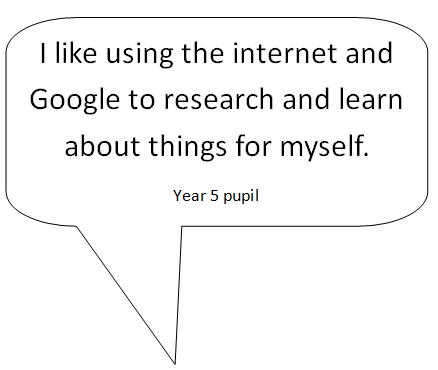
Our Computing curriculum enables children to become life-long learners through teaching them how to access the learning opportunities that technology has to offer. We teach children to access the internet and how to use it to explore their curiosity in a manner that is safe. Our engagement opportunities inspire children to continue to develop their computing skills outside of school.

WoRld Citizens
Using applications such as Google expedition allows children to digitally explore places around the world, enabling them to learn beyond the classroom.
Open to PoSsibilities
The teaching of computing at Ridgeway allows children to explore all aspects of computer science and technology to equip them with the computing skills they may need in an ever-changing digital age and society.
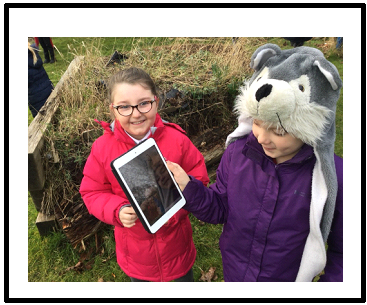
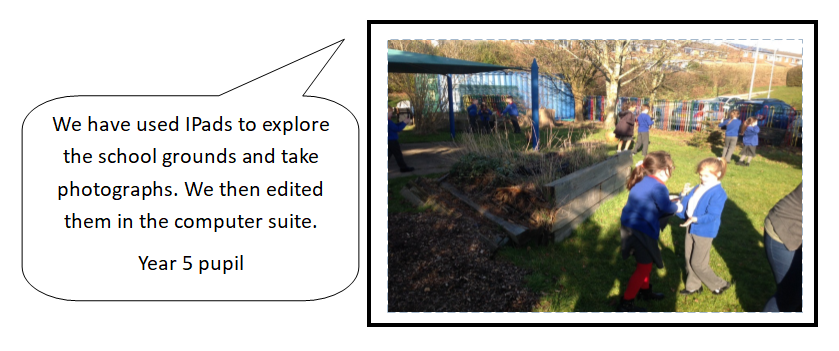
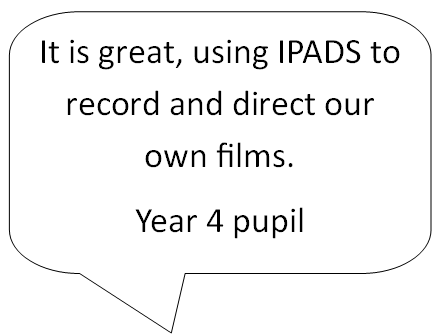
Year 4 children using iPads and cameras to record and create their own films in the forest school.
Implementation
Curriculum Progression
Organisation of the Computing Curriculum
At Ridgeway, our curriculum follows the ‘Switched on Computing’ scheme provided by Rising Stars, which is used as a planning tool in conjunction with Ridgeway’s Computing Progression and Vocabulary Document. Both the scheme and the progression document follow the National Curriculum key skills and programs of study for the primary phase. Staff integrate these units of work in a cross curricular thematic way where possible links can be made. Early years follow their own programme of work, in line with the Early Learning Goals.
Class teachers have worked to place the units in the most suitable point throughout the year to ensure they fit to the holistic teaching that our curriculum follows. Some units are taught stand-alone – for an hour a week – whereas some units are blocked and taught throughout the course of a few weeks.
Regular review and reflect meetings are carried out to ensure that coverage of the curriculum is being met. Teachers, senior leaders and the Computing coordinator review coverage against the ‘Switched on’ Computing scheme as well as Ridgeway’s Progression and Vocabulary Document.
Planning and Teaching
Using the ‘Switched on’ computing scheme and Ridgeway’s Progression and Vocabulary Document, staff then have ownership over the activities that they choose to plan to best match the objectives, skills and vocabulary needed to be taught as well as the needs of the children in their class. Children have the opportunity to use both computers and iPads, which have a variety of applications installed to support the teaching of the computing curriculum. These devices are not only used in computing lessons but they are often used to support all other areas of the curriculum, for example using an iPad to film and evaluate performances in P.E or using computers to aid digital literacy. Computers, tablets, programmable robots, are tools we have at Ridgeway that can be used to acquire, organise, store, manipulate, interpret, communicate and present information. A typical computing lesson allows pupils to explore the internet safely, peer support, develop and implement new skills as well as evaluate products and performance.
Our Computing learning character allows children to understand what lesson they are taking part in, determining the key aspect of learning, especially if links are made across other subjects.
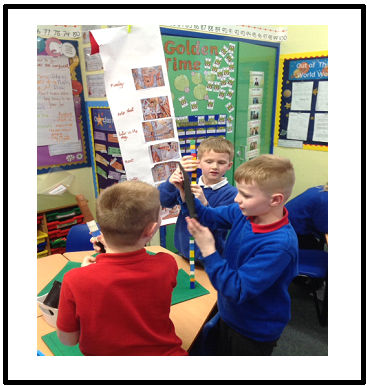
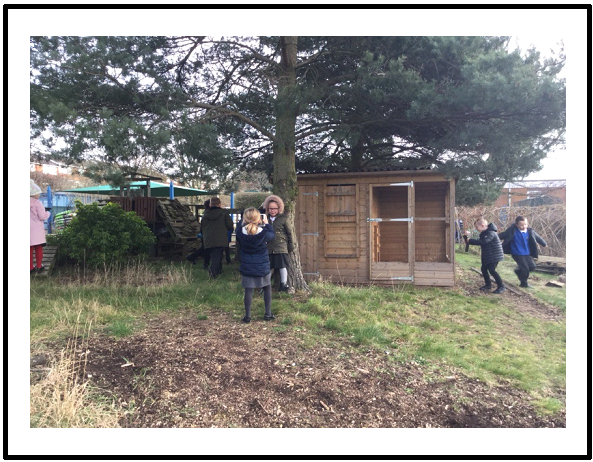
Year 5 exploring forces

Enrichment
Providing learning experiences that are rich and meaningful for our children is a driving force behind the planning, development and teaching of our curriculum. As part of our computing curriculum, children are provided with opportunities that develop their understanding of technology and computing and help to prepare them for the job market of the future.
These opportunities include;
- Working with the physical theatre group Highly Sprung for pupils to engage in bespoke workshops to explore areas of the Computing curriculum in exciting and immersive ways.
- Educational visits to places such as The Think Tank and visitors in school – such as Computer Xplorers.
- In-school computing clubs which give pupils the opportunity to further develop their computing and programming skills.